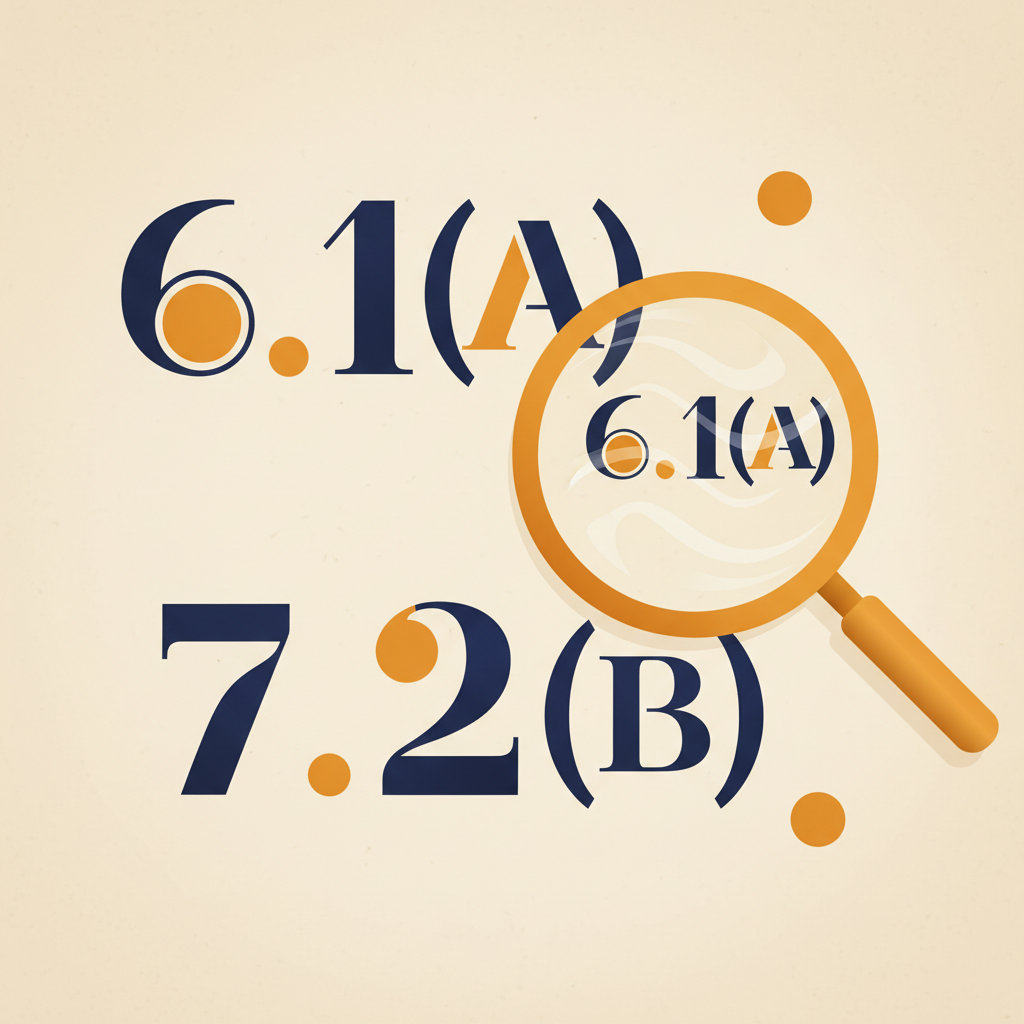
Navigating the Texas Essential Knowledge and Skills (TEKS) can feel like deciphering a secret language. Whether you are a parent looking to understand what your child is expected to master by the end of the school year, or a high school student trying to map out your study plan for a state assessment, you have likely encountered alphanumeric strings like 6.1(A) or 113.18(c)(2). These codes are the backbone of the Texas public education system, defining the curriculum standards for every subject and grade level across the state.
While they may look like random coordinates, these codes follow a rigid, logical structure designed by the Texas Education Agency (TEA). Once you understand the anatomy of a TEKS code, you can stop guessing what a standard requires and start using the official documentation to find exactly what a student needs to know. This guide breaks down the architecture of these standards so you can navigate the Texas curriculum with confidence.
The Anatomy of a TEKS Code: Breaking Down the Syntax
At the surface level, a TEKS code tells you exactly where a standard lives within the Texas Administrative Code (TAC). Most parents and students encounter the "short-hand" version of these codes on report cards, progress reports, or during parent-teacher conferences.
A standard code such as 6.1(A) contains three distinct layers of information:
- The Grade Level (6): This indicates the grade in which the student is expected to master the skill.
- The Knowledge and Skill Statement (1): This is the broader concept or "big idea" that the student is studying.
- The Student Expectation (A): This is the specific, granular skill that the student must demonstrate.
When you see 6.1(A), you are looking at Grade 6, Knowledge and Skill #1, Expectation A. This structure is consistent across most K-8 subjects. However, when you move into high school or look up the official legal text on the TEA website, the codes become more complex because they must reference the specific chapter of the Texas Administrative Code where the subject resides.
Understanding the TAC Structure: Chapters and Subchapters
To find the full text of a standard, you must understand that the TEKS are legally housed within the Texas Administrative Code (TAC). The TEA categorizes subjects by "Chapters." For example, Chapter 111 contains the standards for Mathematics, while Chapter 113 covers Social Studies.
Within these chapters, the standards are further organized into Subchapters:
- Subchapter A: Elementary (Kindergarten through Grade 5)
- Subchapter B: Middle School (Grades 6 through 8)
- Subchapter C: High School (Grades 9 through 12)
- Subchapter D: Other Courses (Often including electives or specialized career and technical education)
If you are looking at a full legal citation, you might see something like 113.18(c)(2)(A). Here is how to parse that:
- 113: The Chapter (Social Studies).
- 18: The specific section (which corresponds to Grade 6 Social Studies).
- c: The subsection (where the actual standards are listed).
- 2: The Knowledge and Skill statement number.
- A: The specific Student Expectation.
By breaking the code down into these segments, you can bypass general summaries and go straight to the primary source documents provided by the state.
Why These Codes Matter for Parents and Students
Understanding these codes is more than just an academic exercise; it is a tool for advocacy and targeted learning. When a student receives a grade on a test or a project, the teacher often identifies specific TEKS that were covered. If a student consistently struggles with a specific area, knowing the TEKS code allows you to research the exact requirement.
For instance, if a student struggles with a math concept, you can look up the standard to see if the requirement is to "solve" a problem, "represent" a concept, or "analyze" data. These verbs are deliberate. A student who is expected to "identify" a geometric shape is held to a different standard than one expected to "calculate" the area of that shape.
For high school students, these codes are essential when preparing for the State of Texas Assessments of Academic Readiness (STAAR) or End-of-Course (EOC) exams. The TEA publishes "Blueprint" documents that list exactly which TEKS are tested on these exams. By identifying your weak spots using these codes, you can focus your study time on the high-priority standards that carry the most weight on the actual exam. At Shrutam US, we organize our content to align with these specific requirements, ensuring that students are not just studying, but studying the right material for their specific grade and course.
How to Navigate the TEA Website Using TEKS Codes
The Texas Education Agency (TEA) website can be dense, but knowing how to use the codes makes it much more accessible. Follow these steps to find the exact standard you are looking for:
- Identify the Subject and Grade: Start by knowing the Chapter (e.g., Chapter 117 for Fine Arts, Chapter 112 for Science).
- Navigate to the TEA Curriculum Standards Page: Search for "TEA TEKS" on your preferred search engine to reach the official landing page.
- Select the Subject Area: Click on the relevant link for your subject. This will bring up a list of all grades and courses associated with that chapter.
- Use the Search Function: Once you open the PDF or web page for the grade level, use your browser’s "Find" function (Ctrl+F or Cmd+F) and type in the number part of the code (e.g., "1.2" for Knowledge and Skill statement 2).
- Read the Preamble: Every set of TEKS includes an introduction. This section is often overlooked, but it contains the state’s philosophy on how that subject should be taught and the foundational skills expected for that year.
Practical Examples of TEKS in Action
To solidify your understanding, let’s look at how these codes function in a real-world classroom scenario.
Example 1: Middle School Mathematics
Consider 7.3(B).
- Grade: 7
- Knowledge and Skill: 3 (Number and operations)
- Expectation: B (Apply and extend previous understandings of operations to solve problems using addition, subtraction, multiplication, and division of rational numbers.)
If a teacher marks a student down for 7.3(B), it means the student is struggling with the mechanics of rational numbers—likely fractions or decimals—rather than the conceptual understanding of the number system itself.
Example 2: High School Biology
Consider 112.34(c)(4)(B).
- Chapter: 112 (Science)
- Section: 34 (Biology)
- Sub-section: c (High School)
- Knowledge and Skill: 4 (Science concepts)
- Expectation: B (Investigate and explain cellular processes, including homeostasis and transport of molecules.)
This code is specific to the Biology EOC exam. When a high school student uses a platform like Aarambha to review for their biology test, they are effectively targeting these specific expectations to ensure they have mastered the vocabulary and the process-based explanations required by the state.
Integrating TEKS into Your Study Routine
Once you understand the structure, the next step is implementation. Whether you are a student or a parent supporting a learner, the goal is to bridge the gap between "homework" and "mastery."
- Review the Blueprint: Before an EOC exam, download the test blueprint from the TEA website. This document will show you which TEKS are "Readiness Standards" (essential for success) and which are "Supporting Standards" (helpful but less critical).
- Use Targeted Practice: Don't waste time on general review. If you know you are struggling with a specific TEKS code, use that code to search for practice problems.
- Connect Concepts: TEKS are designed to be vertical, meaning they build upon one another from year to year. If a student is struggling with a 6th-grade standard, it is often because they haven't fully mastered the 5th-grade prerequisite for that same skill. Use the TEA website to look at the previous grade's version of that standard to identify where the foundation might be shaky.
Platforms like Shrutam US are built with this structure in mind. By mapping our resources directly to these codes, we help students avoid the "firehose" approach to studying—where they try to learn everything at once—and instead focus on the specific standards they need to master to succeed in their current course.
Key Takeaways
- TEKS codes consist of a grade level, a knowledge and skill statement, and a specific student expectation, providing a roadmap for what must be learned.
- The Texas Administrative Code (TAC) organizes these standards into chapters (subjects) and subchapters (grade bands), which are the official legal locations for the curriculum.
- Understanding the "verbs" in a TEKS standard—such as identify, analyze, or calculate—is crucial for knowing exactly how a student will be evaluated.
- The TEA publishes test blueprints that identify which TEKS are most heavily weighted on state assessments, allowing for smarter, more efficient study habits.
- Vertical alignment means that struggling with a current TEKS code often stems from a gap in a foundational standard from a previous grade.
- Using official TEA resources alongside supplemental study platforms helps bridge the gap between classroom instruction and exam-day performance.